Build Fight
- 4.5
- Rating
- 1.00M
- Installs
- Free
- Price

 Analysis by App-foxy
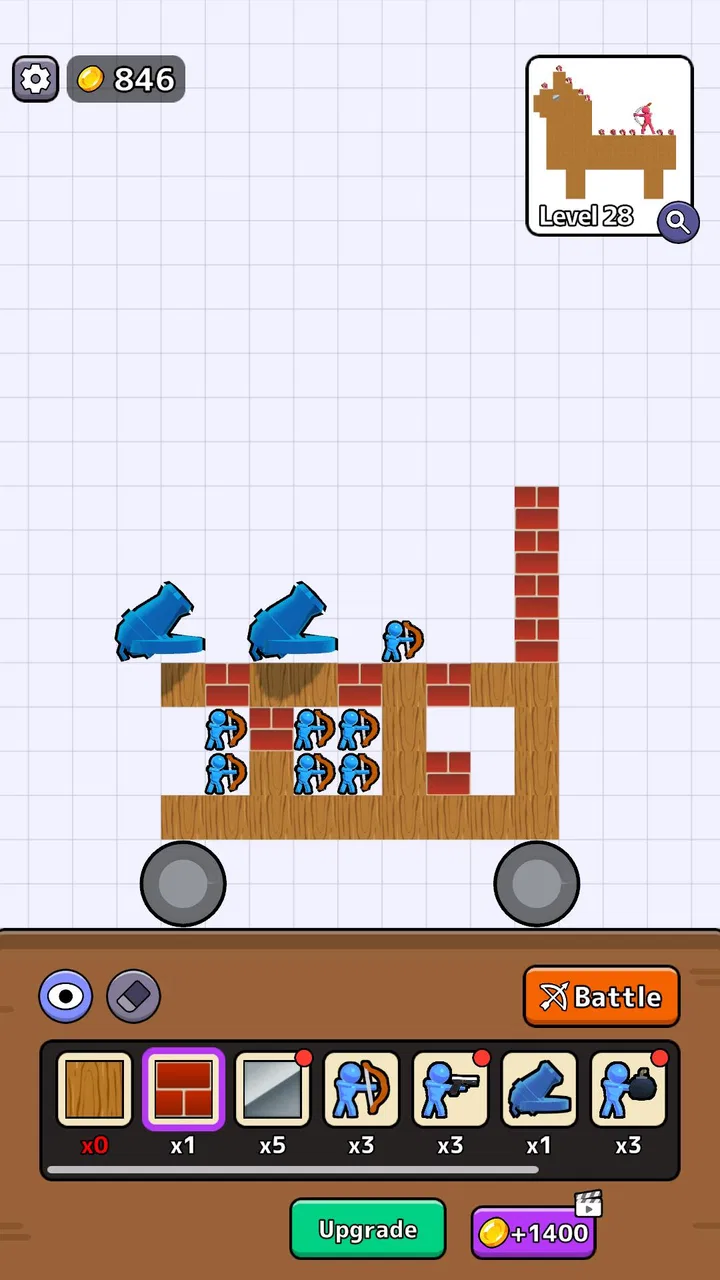
I went into Build Fight expecting a quick arcade distraction, and that is exactly where it makes the strongest impression. Its central idea is easy to understand: build with blocks, then use that construction in a fight. The appeal is immediate because there is no long explanation to absorb before the game starts feeling active. I can pick it up when I have only a few spare minutes, understand the basic objective quickly, and decide almost at once whether I want another round.
That simplicity is also the game’s main test. A short-session arcade title cannot rely on a long story, deep menus, or a large collection of systems to keep me interested. It has to make the first moments satisfying and give me a reason to return after the novelty fades. KAYAC Inc. has aimed this release at that compact, energetic space, and the result feels best when I treat it as a small burst of play rather than a game I need to sit with for an entire evening.
Why the block-building idea works so quickly
The most enjoyable part of the concept is the tension between making something and immediately putting it under pressure. Building normally suggests patience, planning, and control. Fighting suggests reaction, disruption, and risk. Combining those ideas gives each action a little more weight than a standard tap-heavy arcade challenge. Even a simple structure can feel useful when it changes what I can do during the confrontation.
You May Also Like

 Blood Strike: 2.5 Anniversary
Blood Strike’s Loadouts Turn Every Drop Into a Tactical Gamble
A close look at Blood Strike’s custom loadouts: how fast access to signature weapons reshapes its battle royale rhythm, rewards preparation, and narrows the gap between fights.

 Pandora - Music & Podcasts
Pandora’s Music Is Easy to Start, but Harder to Recover
Pandora’s strength is its low-effort path from a seed to a station. Its weak spot is how much confidence it asks you to place in connection, setup, and quiet recovery.

 8 Ball Pool
 Is Built on Rivalries, Rematches, and Routine
A close look at the rivalries, rematches, shared routines, and unanswered safety questions that turn a quick pool match into a persistent mobile community.

 Samsung Music
’s Quiet Strength Is Playing What You Already Own
Its reach comes less from spectacle than from dependable access to a personal library. That simplicity is both the app’s strongest retention engine and its ceiling.

 AccuWeather: Weather Radar
AccuWeather Review: A Quick, Clear Forecast for Everyday Decisions
For everyday plans, the best forecast is the one you can understand quickly. AccuWeather makes rain timing, radar, and local conditions easy to act on, with a few trade-offs.

 Hill Climb Racing
Why Hill Climb Racing Still Turns Crashes Into One More Run
A tiny car, a bumpy hill and one more upgrade: Hill Climb Racing keeps resurfacing because its simple chaos makes every near-miss feel personal.
More From Our News Desk



I also like that the game does not ask me to learn a complicated fictional world before I can enjoy it. The store summary, “Building in blocks!”, communicates the basic identity clearly, while the short description, “Build Fight,” points toward the conflict at the center. Those phrases are brief, but they match the experience better than an elaborate explanation would. This is a game I can show to somebody else and explain in one sentence without losing the point.
That clarity matters particularly on a phone. Mobile games compete with messages, travel, waiting rooms, and all the small interruptions that divide a day. Build Fight benefits from having a premise that survives those conditions. If I stop thinking about it for a while, I do not return wondering which character I was following or what piece of a complicated plan I had forgotten. I can look at the current situation, rebuild my understanding in a moment, and continue.
My first useful tip is to avoid treating every construction choice as permanent. The instinct is to build the biggest or most impressive arrangement immediately, but the fighting side makes that approach risky. A smaller, more deliberate build can be easier to understand and adjust. I found the game more enjoyable when I thought in terms of a quick test: make a practical arrangement, see how it behaves under pressure, and change my approach on the next attempt instead of trying to perfect everything beforehand.
A rhythm made for short sessions
The strongest rhythm comes from the handoff between preparation and action. Building gives me a moment to make a decision, while the fight gives that decision a consequence. That contrast prevents the experience from becoming a completely flat sequence of identical taps. Even when the available actions feel straightforward, the change of pace creates a small sense of anticipation: I am not merely placing blocks, I am about to find out whether my idea was useful.
This makes the game a good fit for the ordinary gaps in a day. I can imagine playing while waiting for an appointment, during a short commute when it is safe to do so, or between larger tasks at home. The important point is that it does not demand the emotional commitment of a long arcade run. I can enjoy a brief attempt, put the phone away, and come back later without feeling that I have abandoned a major campaign.
There is a trade-off here. Players who want a large arcade package with many separate modes, extensive progression, or a constant stream of new rules may find this narrow focus limiting. Build Fight’s pleasure comes from refining the central loop, not from surrounding it with a huge amount of content. I would recommend it to someone who values immediate interaction over a long checklist of unlocks. I would not choose it as my main game if I wanted a deep competitive system or a long-form adventure.
The game’s free price lowers the barrier to trying it. That makes sense for this kind of compact arcade experience: I do not need to make a major commitment before finding out whether the building-and-fighting combination suits me. It is also easier to recommend casually to a friend because the decision is about taste and play style rather than whether the purchase is worth making. The sensible approach is to try it during a short break and judge how strongly the loop pulls me toward one more attempt.
What happens when real life interrupts
For me, interruption tolerance is one of the most important qualities in a mobile arcade game. Build Fight is at its best when I can leave it mentally without losing the basic thread. Its premise is self-contained, so returning after checking a message or handling a small task feels less demanding than returning to a game that expects me to remember a long chain of objectives.
Still, I would not confuse simple rules with guaranteed convenience in every situation. A player should pay attention to the point at which they leave, especially if they are in the middle of an active exchange. The difference between stepping away during a quiet preparation moment and stepping away during a decisive fight can affect how comfortable the return feels. My practical habit would be to finish the current action or wait for a natural pause before closing the game whenever possible.
This is also where the game compares favorably with many traditional arcade alternatives. A score-attack game built around constant movement can punish even a brief distraction. A puzzle game may leave me staring at a board and trying to reconstruct a plan after I return. Build Fight’s block-and-conflict structure gives me a clearer mental reset. I can ask myself two simple questions: what am I building, and how is it helping me fight? That is usually enough to get back into the experience.
One less obvious use case is sharing the game with someone who does not normally play mobile titles. The basic idea is easy to demonstrate without a tutorial lecture. I can let a friend try a construction choice, watch how it holds up, and discuss the result immediately. That makes the game more suitable for casual handoffs than an arcade title whose enjoyment depends on memorizing a large control scheme.
When the first impression starts to wear off
The real question is replay value. The initial combination of blocks and combat is memorable because it joins two familiar activities in a compact way. After several sessions, however, the experience depends on whether I still enjoy experimenting with the same basic relationship. If I need constant novelty to stay interested, the game may feel lighter over time than its first few rounds suggest.
I found the best way to extend its life was to set myself small personal challenges rather than expecting the game to provide a completely different experience every time. I could try building more efficiently, make choices with less hesitation, or focus on understanding why a particular arrangement worked better than another. This turns repetition into practice. It is not the same as having a large progression system, but it gives the central loop more room to breathe.
Another useful approach is to separate “winning” from “learning.” If a round goes badly, I can still get value from noticing whether I built too quickly, ignored the fight, or relied on a structure that looked promising but did not help in practice. That mindset suits Build Fight because the concept naturally invites comparison between intention and result. The game becomes more interesting when I treat each attempt as a small experiment instead of demanding that every one feel fresh.
There is a clear limit, though. Someone who dislikes repeating a compact arcade loop will probably not be persuaded by this kind of self-imposed challenge. In that case, a larger arcade collection or a game with a stronger campaign would be a better choice. Build Fight is not the right recommendation for a player who wants a constant stream of story beats, extensive customization, or a long-term hobby with many unrelated activities.
The current release is version 039, and the game has already attracted over one hundred thousand installs with an average rating of 4.6 from around one thousand one hundred ratings. Those figures suggest that the straightforward concept has found an audience, but they do not replace personal testing. I would read them as a reason to give the game a fair try, not as proof that every player will find its repetition satisfying.
Who will enjoy it most
I would put Build Fight near the top of my list for people who want a free arcade game that explains itself quickly and delivers a focused interaction. It is especially suitable for players who like making a small plan and immediately seeing whether that plan survives contact with an opponent. The building element gives the game a little more thought than a purely reflex-based distraction, while the fighting keeps the preparation from becoming slow or overly careful.
It can also work for players who frequently play in short bursts. If I have only enough time for a quick attempt, I can still engage with the main idea instead of spending the whole session navigating menus or remembering a complicated objective. That makes it a practical companion for fragmented schedules, provided I am comfortable with a game whose appeal is concentrated in one central loop.
I would be more cautious recommending it to someone who wants a relaxing construction toy. The word “build” might suggest a calm creative space, but the game’s identity includes conflict, so the satisfaction comes from construction under pressure rather than from quietly decorating or designing without opposition. Likewise, players looking for a highly technical fighting game should keep their expectations measured. The block-building premise is the star; it is not simply a conventional fighter with decorative objects added on top.
The Teen age rating is another reason I would consider the audience before handing it to a younger player. I would not describe it as a universal family pick based only on its simple presentation. A parent should make the decision with the rating in mind, while older players can approach it as a quick arcade experience rather than assuming that its block-based appearance tells the whole story.
How it compares with familiar arcade choices
Compared with a classic reflex arcade game, Build Fight gives me more ownership over what happens before the action. I am not only reacting to objects arriving on screen; I am also making a construction choice that shapes the next moment. That extra step makes the game more thoughtful without turning it into a slow strategy title.
Compared with a pure building game, it is more urgent and less meditative. The pressure of fighting means I cannot judge a structure only by how it looks or how satisfying it is to assemble. It has to serve a purpose. This is the game’s clearest point of difference, and it is also the reason some players may prefer a different option. If I want creative freedom without consequences, a construction-focused alternative will suit me better.
Compared with a larger action game, Build Fight is easier to enter and easier to leave. I do not need to invest a full evening to feel that I have played it properly. The cost of that convenience is scope. A bigger title may offer more variety, deeper systems, and stronger long-term goals, while this game asks me to find enjoyment in improving my handling of one compact idea.
My practical comparison is simple: choose Build Fight when the question is “Can I have a clear, active arcade moment right now?” Choose something else when the question is “Which game will occupy me for weeks with a broad progression path?” Both are valid needs, but they are not the same need.
Small habits that make the loop more satisfying
I recommend beginning with observation rather than speed. The temptation in an arcade game is to act immediately, but the building stage is where I can create an advantage. Taking a brief moment to understand what I am trying to accomplish makes the following fight feel more connected to my decision instead of random.
I also try not to rebuild my entire approach after every disappointing result. Changing one choice at a time gives me a better sense of cause and effect. If I alter everything, I may succeed without understanding why, or fail without learning what went wrong. This gradual method is particularly useful in a game built around the relationship between construction and combat.
Finally, I use the game as a break rather than as a commitment. That sounds obvious, but it protects the experience from its own limitations. When I expect a short, focused burst, the narrow design feels intentional. When I expect endless variety, I start noticing the boundaries too quickly. The right session length is therefore part of the recommendation: play it when you want a compact challenge, then stop while the idea still feels sharp.
My casual verdict
Build Fight is a focused arcade game with a clear hook and a useful advantage on mobile: I can understand what it wants from me almost immediately. The block-building setup gives ordinary action a planning step, and the fight gives each construction decision a reason to matter. I enjoyed it most in short sessions, especially when I approached each attempt as a quick test rather than expecting a complete long-term game.
Its weaknesses are connected to that same focus. The loop may not offer enough variety for players who need constant change, and the simple presentation should not be mistaken for a deep construction simulator or a full fighting game. It is also better for people who can accept repetition and find satisfaction in improving small decisions. If that sounds like you, the free entry point makes it easy to try without much risk.
KAYAC Inc. has made something that fits the casual arcade category honestly. It does not need a complicated explanation to create a moment of curiosity: build something, put it into conflict, and see what happens. With its Teen rating, support for Android 7.0 and later, and a release dated December 3, 2025, it is a current option for players who want a compact game rather than a sprawling one.
My recommendation is straightforward: give Build Fight a chance if you enjoy immediate rules, brief sessions, and the small satisfaction of adjusting a plan after seeing it tested. I would skip it if I were searching for a deep campaign, a peaceful building sandbox, or a large arcade package with many unrelated modes. For the right player, its best quality is not endless content but the ability to create a quick decision, watch it face pressure, and return for one more attempt without a long explanation.
FAQs for Build Fight
01What is Build Fight and what can I expect from the gameplay?
Build Fight is an action-packed mobile game that combines elements of construction and combat. Players can expect to engage in intense battles while strategically building structures for defense and attack. The game offers various modes, allowing for solo play or teaming up with friends. With a range of weapons and tools, creativity and quick thinking are key to mastering the game.
02Is Build Fight available for both Android and iOS devices?
Yes, Build Fight is available for download on both Android and iOS platforms. Users can find the game on the Google Play Store for Android devices and the Apple App Store for iOS devices. Check the compatibility requirements for your device to ensure a smooth gaming experience.
03Are there in-app purchases in Build Fight?
Build Fight offers in-app purchases that can enhance your gaming experience. Players can choose to buy skins, weapons, and other cosmetic items. While these purchases can enrich gameplay, they are entirely optional, and players can enjoy the game without spending money. It's recommended to monitor in-app purchases if children are playing.
04What are the system requirements for running Build Fight smoothly?
To run Build Fight smoothly, your device should meet certain specifications. For Android, a minimum of 2GB RAM and Android version 5.0 or higher is recommended. For iOS, devices running iOS 10.0 or later are compatible. Sufficient storage space is also necessary to accommodate game updates and new content.
05Does Build Fight offer any multiplayer features?
Yes, Build Fight includes multiplayer features that allow players to team up with friends or battle against others online. The game supports real-time multiplayer modes, offering a dynamic and engaging experience. Players can join clans, participate in tournaments, and climb the leaderboards to showcase their skills.
Pros
- Intuitive controls make gameplay smooth.
- Diverse character customization options.
- Regular updates with new content.
- Engaging multiplayer modes.
- Visually appealing graphics.
Cons
- In-app purchases can be costly.
- Occasional server connectivity issues.
- High battery consumption.
- Requires consistent internet connection.
- Some ads disrupt gameplay.

Build Fight
Gallery